Firewalls
Introduction
A firewall is a network security system that monitors and controls incoming and outgoing network traffic. It helps protect computers, networks, and devices from unauthorized access and potentially harmful network activity.
Firewalls can be implemented as hardware, software, or a combination of both. They are an important part of modern network security.
What Is a Firewall?
A firewall acts as a security barrier between a trusted network and an untrusted network, such as the Internet. It examines network traffic according to a set of security rules and decides whether the traffic should be allowed or blocked.
For example, a firewall may allow normal web traffic while blocking unauthorized connection attempts.
How a Firewall Works
A firewall monitors network traffic and applies predefined security rules.
The basic process is:
- A device sends or receives network traffic.
- The firewall examines the traffic.
- It checks the traffic against its security rules.
- If the traffic is allowed, the firewall permits it to continue.
- If the traffic violates the rules, the firewall blocks or rejects it.
Modern firewalls may examine additional information, such as IP addresses, ports, protocols, connection states, and application-level information.
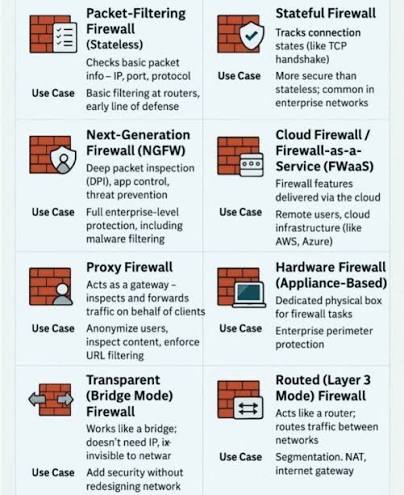
Types of Firewalls
1. Packet-Filtering Firewall
A packet-filtering firewall examines individual network packets and makes decisions based on information such as source and destination IP addresses, ports, and protocols.
2. Stateful Inspection Firewall
A stateful firewall keeps track of active network connections. It can make decisions based on the state and context of a connection rather than examining each packet independently.
3. Proxy Firewall
A proxy firewall acts as an intermediary between a user and an external network. It can inspect traffic before forwarding requests to their destination.
4. Next-Generation Firewall (NGFW)
A next-generation firewall provides advanced security features such as application awareness, deeper traffic inspection, and integration with other security controls.
5. Host-Based Firewall
A host-based firewall is installed directly on an individual computer or server. It controls network traffic entering or leaving that particular device.
6. Network Firewall
A network firewall protects multiple devices or an entire network. It is commonly placed at the boundary between an internal network and an external network.
Advantages of Firewalls
- Helps prevent unauthorized network access.
- Monitors incoming and outgoing traffic.
- Can block unwanted or suspicious connections.
- Helps protect sensitive systems and data.
- Allows organizations to enforce network security policies.
- Can provide logging and monitoring information.
- Can reduce exposure to certain network-based threats.
Disadvantages of Firewalls
- Requires correct configuration and regular maintenance.
- A poorly configured firewall may block legitimate traffic.
- A firewall cannot protect against every type of cyber threat.
- Advanced firewall solutions can be expensive.
- Users may experience connectivity problems if security rules are too restrictive.
- Firewalls need to be combined with other security measures for comprehensive protection.
Uses of Firewalls
Firewalls are commonly used in:
- Home networks.
- Schools and universities.
- Businesses and organizations.
- Data centres.
- Cloud environments.
- Government networks.
- Servers and individual computers.
Firewall vs. Antivirus
A firewall and antivirus software provide different types of protection.
| Feature | Firewall | Antivirus | |---|---|---| | Main purpose | Controls network traffic | Detects and removes malicious software | | Primary focus | Network connections | Files, programs, and system activity | | Blocks unauthorized connections | Yes | Not its primary function | | Detects malware | Limited or indirect | Yes | | Works with network rules | Yes | Usually not the main function |
Both technologies can work together as part of a broader cybersecurity strategy.
Firewall vs. Router
A router primarily forwards data between different networks, while a firewall focuses on controlling and securing network traffic. Many modern routers include built-in firewall features, but routing and firewalling are separate functions.
Importance of Firewalls
Firewalls are important because they provide a layer of protection between systems and potentially untrusted networks. They can help organizations control access to network resources, reduce unwanted traffic, and monitor connections.
However, a firewall should not be considered a complete security solution. Strong passwords, software updates, antivirus or endpoint protection, secure configurations, user awareness, backups, and other security controls are also important.
Conclusion
A firewall is an important network security mechanism that monitors and controls network traffic according to defined security rules. Firewalls can be implemented on individual devices, network infrastructure, or cloud environments.
Although firewalls provide valuable protection against unauthorized network access, they are most effective when used together with other cybersecurity measures. Understanding how firewalls work is therefore an important part of learning computer networking and cybersecurity.